October 6, 2026 · Development notes
Paperlore: Tangram — starting a new paper story
Our next Paperlore game begins with geometric shapes and a book we want to bring to life. Here are the early sketches and the ideas we are already testing on a phone.
After Paperlore: Jigsaw, we have started a separate game: Paperlore: Tangram. Paper stays at the heart of it, but the puzzle changes. Instead of joining fragments of an existing picture, you build silhouettes from geometric pieces. We want to explore different sets, sizes and numbers of pieces, beyond the classic seven.
From a notebook cat to a whole book
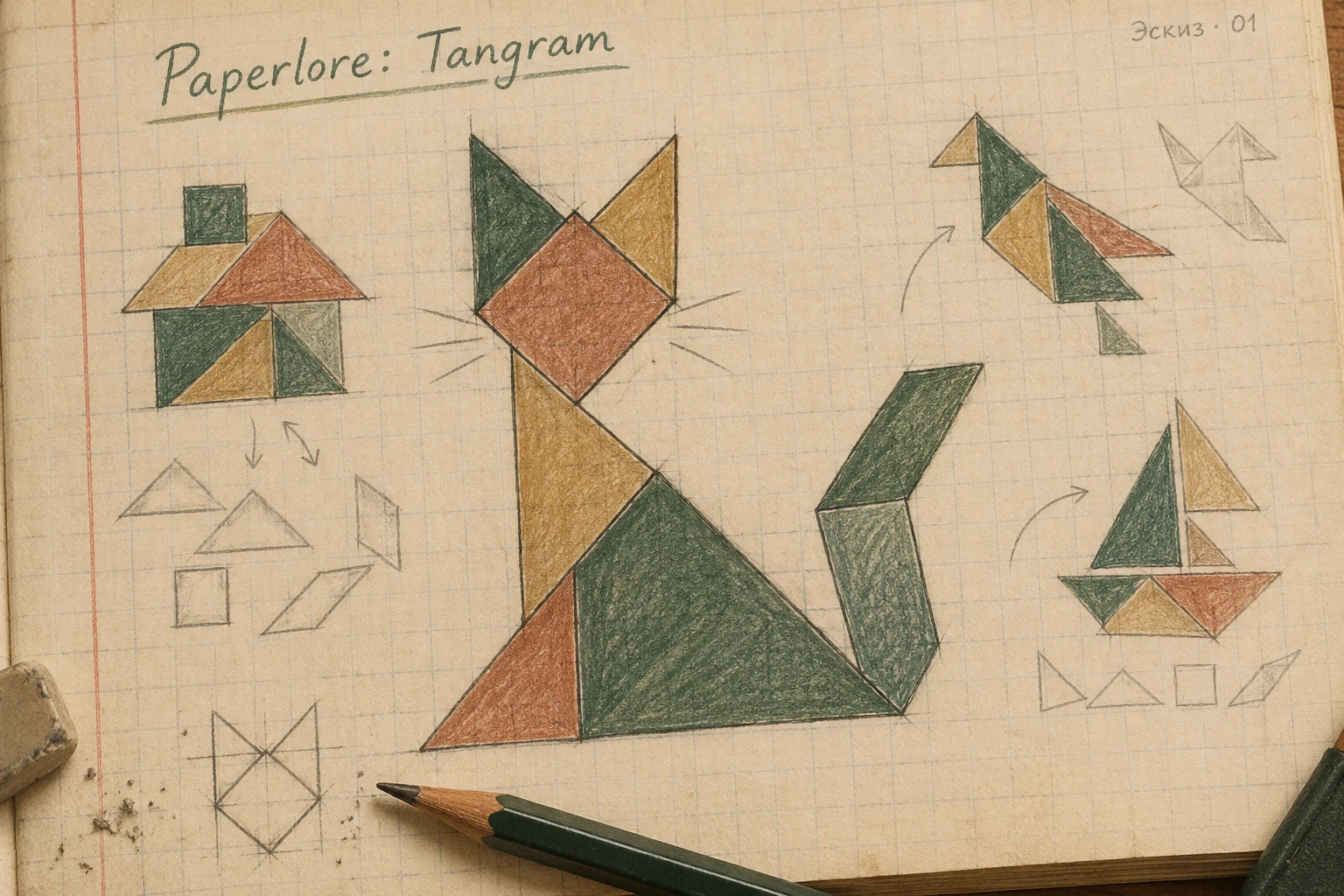
One of the first sketches shows a cat on squared paper, surrounded by a house, a bird and a boat. It gives us something concrete to discuss: how a handful of simple shapes can become a recognisable character. It is not a level blueprint. Every playable silhouette will need to be built and checked separately to make sure the supplied pieces can actually form it.
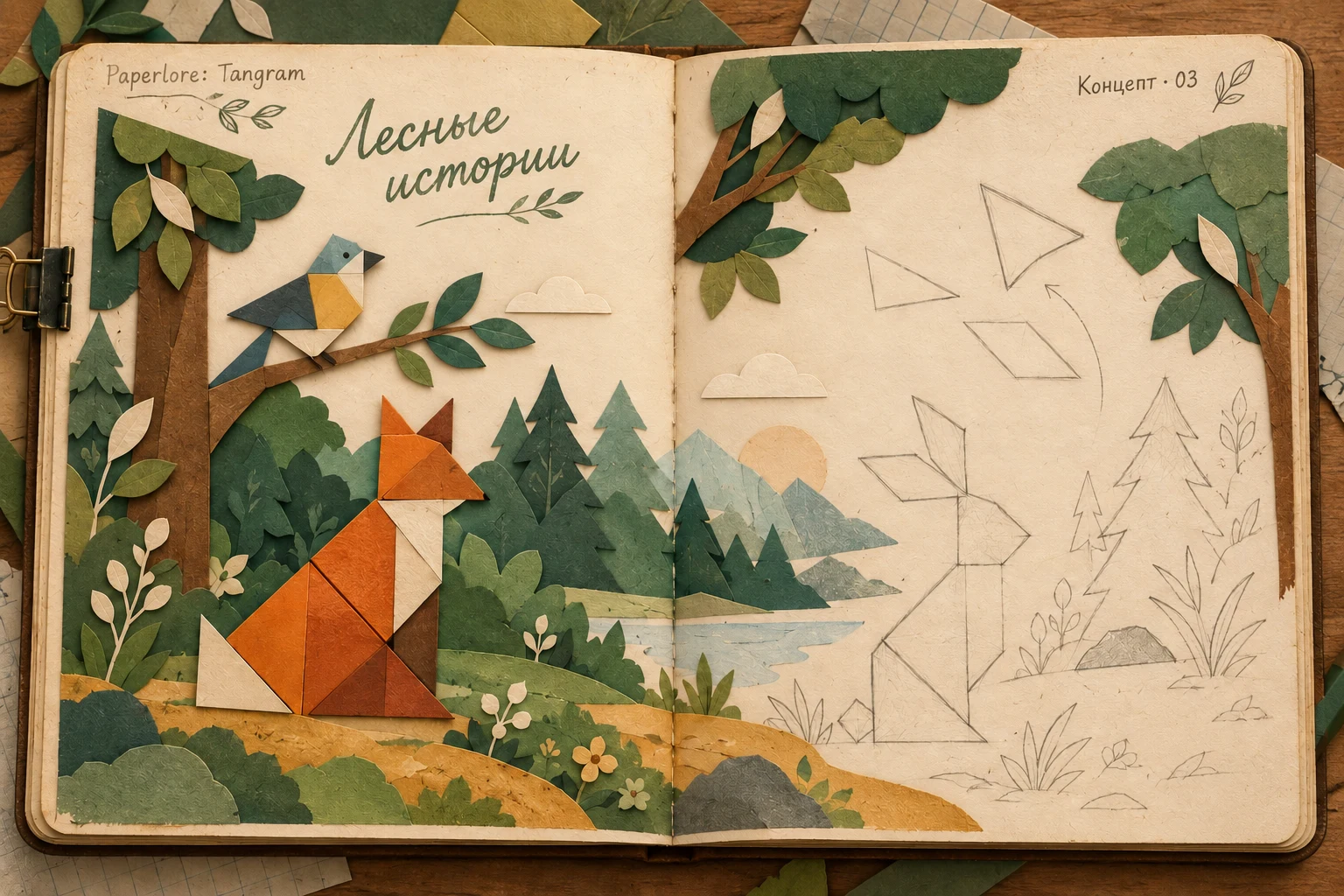
Those individual figures led us to the direction we have chosen: a game shaped like a book. Unfinished pencil sketches sit on its pages. As players solve puzzles, the sketches become colourful paper cutouts and a sparse scene gradually fills with life. In the forest concept, the fox and bird are already there, while the rabbit is still waiting.
We want turning a page to feel like a natural step forward: finish one episode, then open the next. That does not mean one puzzle per page. We still need to work out how many figures belong on a spread and when it is time to turn it.
Who the story is for
We are thinking first about children and families playing together. Getting started should be straightforward, with later puzzles giving adults something to think about too. We plan to build up the difficulty and introduce different techniques from chapter to chapter, once those techniques have been tested in the lab.
One possibility is to follow a main character through the book, bringing a fairy tale to life through the puzzles. Neither the character nor the story has been chosen. We also want to try final “boss builds”: trickier shapes with unusual pieces or a combination of familiar rules. They might close an episode or a chapter, but their frequency and role in the story are still open questions.
On the phone, it is still a lab
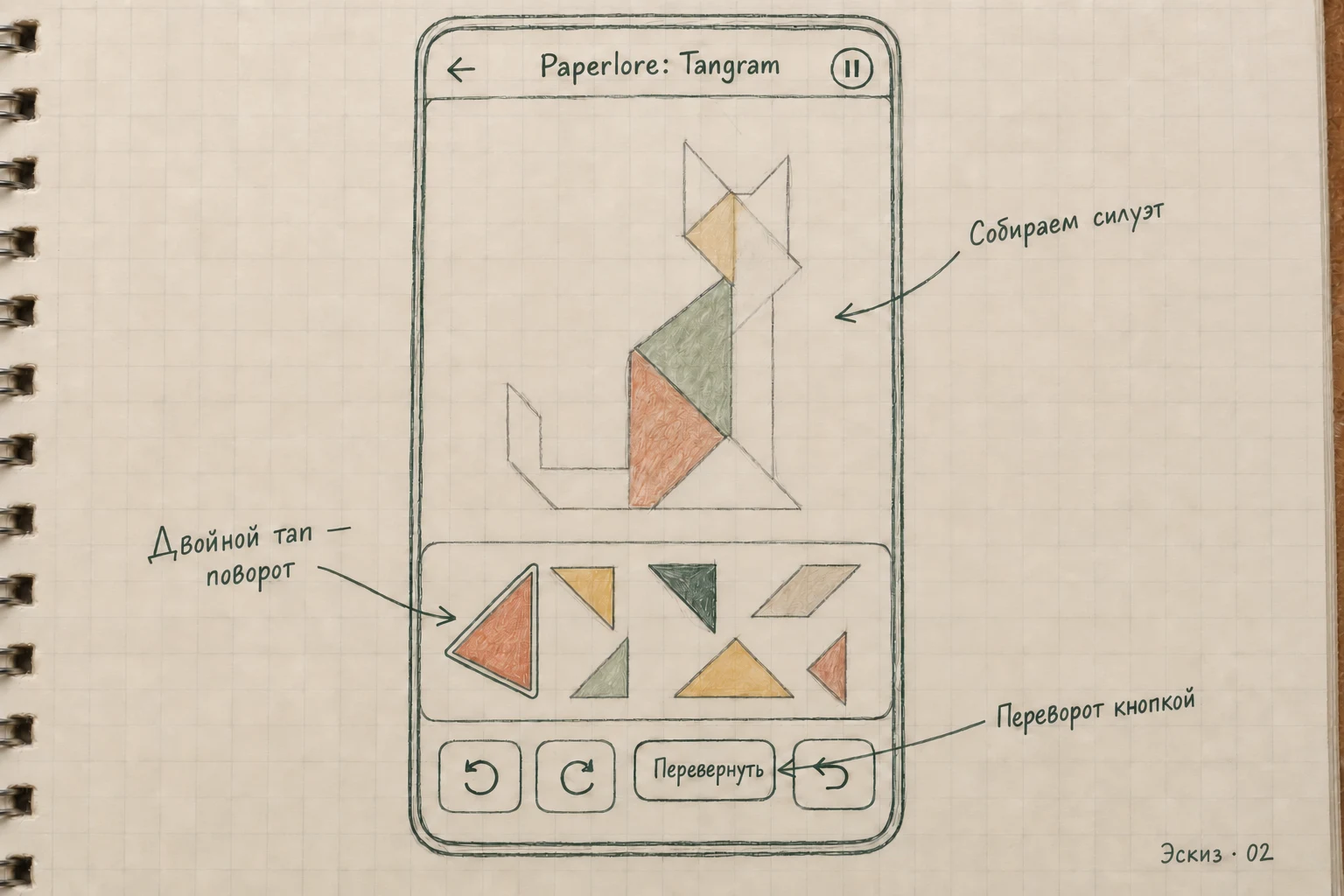
Behind the book spreads is a fairly modest Android app called Tangram Lab. It has three basic scenes where we can move pieces, rotate them in 45-degree steps, flip them, undo actions and start again. Snapping and coverage checks help us test how the pieces fit the target. We are working on these foundations before building the game around them.
We recently fixed an annoying jump when a finger released a piece, and checked the fix on a Pixel 7. Smooth rotation and flipping have also been added and tested on an emulator so far. Small details, but they make a difference to whether a paper piece feels comfortable to handle.
Next we need to check that actions give repeatable results, test state restoration and recorded-session replay, and measure performance. Then come experiments with new mechanics. For now, the book world shows where we want to go, not a game that is already built.
All three illustrations in this post are AI-generated concepts. They help us choose a mood and discuss ideas; they are not evidence of finished screens or validated geometry. We have not set a release date, a world or level count, or the final star rules. The priority now is to make the puzzles feel right, and discover which story really belongs in this book.
← All stories